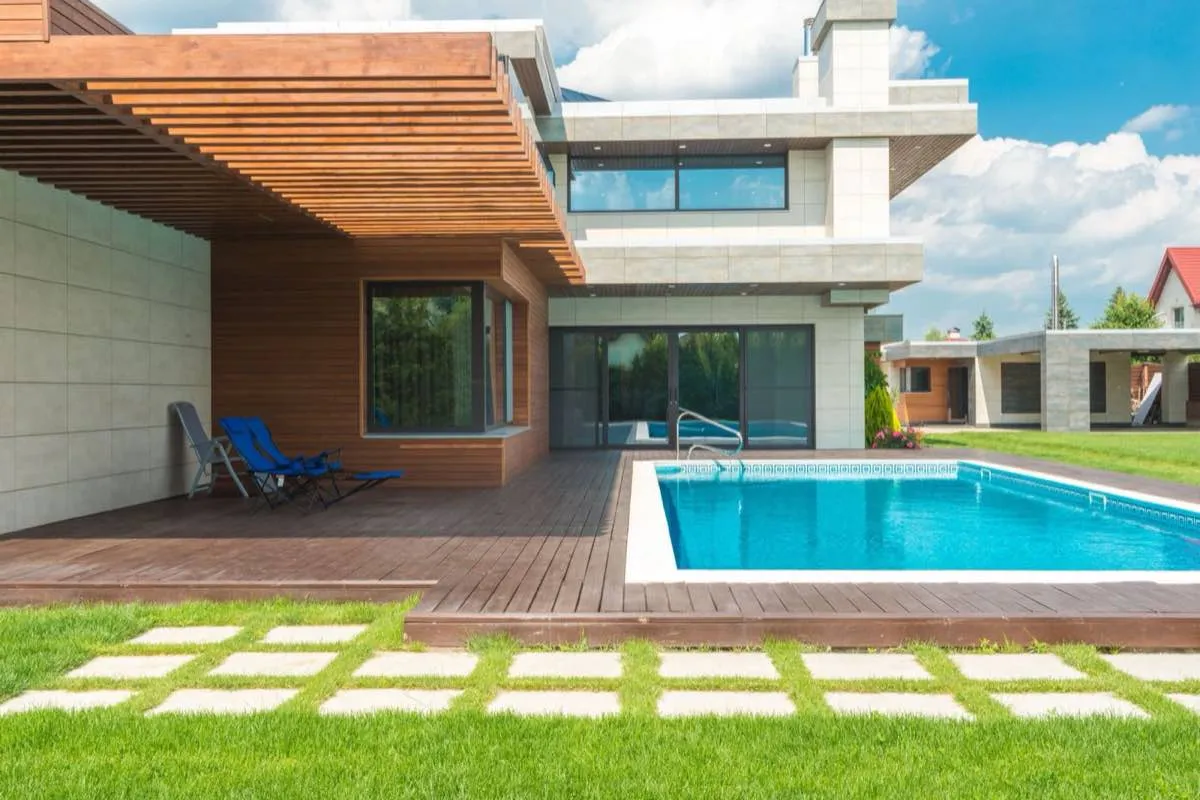
Short version: a fiberglass pool is faster to install, easier to maintain, and gentler on your chemical budget — but you're locked into a manufactured shape and size. Gunite is fully custom and lasts longer, but it costs a resurface every decade or so and takes two to three months to build. Pick fiberglass for speed and low fuss, gunite for a one-of-a-kind backyard. Neither one is "the winner," despite what every pool builder with a favorite will tell you.
Here's the part nobody says out loud at the showroom: most builders push whichever pool they're set up to sell. The fiberglass guy swears concrete is a maintenance trap; the gunite guy swears fiberglass is a glorified bathtub. Both are half right. Let's break it down the way we'd explain it standing in your Cape Coral backyard, with a tape measure and zero commission on the line.
The 30-second comparison
| Fiberglass | Gunite (concrete) | |
|---|---|---|
| Upfront cost | Mid-$40k–$85k installed | Mid-$40k–$70k+ installed |
| Install time | 3–6 weeks | 8–12 weeks |
| Shapes & sizes | Preset molds (max ~16 ft wide) | Any shape, any size |
| Surface | Smooth, non-porous | Rougher plaster |
| Maintenance | Low (fewer chemicals) | Higher (brushing, chemicals) |
| Big recurring cost | Gel-coat refinish ~25–30 yrs | Replaster every 10–15 yrs |
| Shell lifespan | 25–30 yrs | 50+ yrs (with resurfaces) |
| Salt system | Loves it | Fine, but salt is rough on plaster |
If your eyes glazed over, here's the one-liner: fiberglass is the "get me swimming with less hassle" pool; gunite is the "build me exactly what I pictured" pool.
Cost: closer than you'd think
Everyone leads with price, and everyone gets the answer wrong. The material isn't what moves the number most — your site does.
A fiberglass pool in Cape Coral typically runs the mid-$40,000s to about $85,000 installed. The shell shows up on a truck as one finished piece, which saves labor, but that same truck needs room to swing a crane into your yard. Tight access, a fence to remove, a slope to deal with — that's where the price climbs.
A gunite pool usually lands in the mid-$40,000s into the $70,000s and up, and the sky's the limit once you add spas, tanning ledges, and rock features. It's built in place, so access matters less, but the labor is much higher.
On a basic build, the two are often within a few thousand dollars of each other. Where they split is over ten years. Fiberglass costs almost nothing to maintain and won't need refinishing for decades. Gunite needs a resurfacing every 10 to 15 years — figure $5,000 to $12,000 each time — to keep the plaster smooth and sealed. So gunite's true cost is the sticker plus a resurface or two down the road.
Install time: weeks vs. a whole summer
This is the one people underestimate. A fiberglass shell drops in a day or two, and the full a new pool or a full remodel — excavation, set, plumbing, decking, backfill — usually wraps in 3 to 6 weeks. You can order a pool in spring and swim by early summer.
Gunite is a build, not a delivery. Excavate, tie steel, spray the concrete, let it cure, tile, plaster, deck — it's 8 to 12 weeks of a construction site where your lawn used to be. Start in April and you might be doing cannonballs by July. Start in June and you're admiring it in October.
If you've ever lived through a backyard project, you know the real cost of "8 to 12 weeks" isn't just time — it's the mud, the fencing, and the extension cord running through your kitchen window.
Customization: preset shell vs. blank canvas
Fiberglass comes in molds. That means a curated menu of shapes, and a hard ceiling around 16 feet wide (that's the widest a shell can travel down a highway without a police escort). The good news: those molds now come with built-in benches, steps, and tanning ledges, so "preset" isn't as limiting as it sounds.
Gunite is a blank canvas. Any shape, any depth, any size, wrapped around a tree if you want. Vanishing edge, beach entry, an attached spa that spills into the pool — if you can draw it, gunite can be it. That freedom is exactly why high-end custom backyards and any serious pool remodeling job lean gunite.
Maintenance and lifespan: the honest trade
Fiberglass has a smooth, non-porous gel coat. Algae can barely get a grip, so you brush less and dose fewer chemicals — real savings over a long Lee County and Southwest Florida swim season. The shell itself lasts 25 to 30 years before that gel coat wants refinishing.
Gunite's plaster is porous and a touch rough, which algae treats as beachfront property. You'll brush more and run your chemistry tighter. But the shell is nearly bulletproof — 50-plus years is normal — as long as you budget for that periodic replaster.
The part the builders skip: match the pool to your plans, not their pitch
Here's where we'll actually take a side, because "it depends" is a cop-out.
Choose fiberglass if a standard shape fits your yard and you want low upkeep — especially if you run a saltwater system. Salt is easy on a fiberglass gel coat and slowly chews at gunite plaster, which is one more reason saltwater pools and fiberglass are a natural pair. If you're not planning to grow old in this house, fiberglass also spares the next owner a looming replaster bill.
Choose gunite if you want a shape or size fiberglass can't mold, or you're staying put for the long haul. Over 30-plus years in the same backyard, a gunite shell's longer life and full customization earn their keep — even with the resurfaces.
The two things that should decide this — how long you'll own the home, and whether you run salt — are the two things a commissioned salesperson almost never asks about. That's the tell.
So which one for a Cape Coral backyard?
For a Cape Coral homeowner who wants to swim this season and a stock shape happens to fit the yard: fiberglass is a fair choice. The fast install and low maintenance are real, and nobody should pretend otherwise.
For anyone building a showpiece — custom shape, big footprint, spa, the works — gunite, full stop. Fiberglass simply can't mold what you're picturing.
And if your yard has tight access, a high water table, or expansive soil, don't guess. Those site conditions can flip the math and even rule one option out. That's a look-at-it-in-person call, not a Google call.
The bottom line
Fiberglass vs gunite isn't good vs bad. It's fast-and-low-fuss vs fully-custom-and-long-lived. Match the pool to your yard, your salt setup, and how long you're staying — not to whichever one the builder happens to stock.
Cape Coral Pool Builders builds concrete pools across Cape Coral and Lee County and Southwest Florida, so that is the side of this we quote — along with pool remodeling and resurfacing on the pool you already have. If a stock fiberglass shell is the better fit for your yard, we will say so on the site visit rather than sell you a gunite shell you did not need. Free quote, no pressure: call (888) 688-7515.
Ready for a free quote in Cape Coral?
Cape Coral Pool Builders — free estimate, clear scope, no pressure. Use the form on this page or jump to the homepage quote.
Related services in Cape Coral
Cape Coral Pool Builders money pages — go straight to the service you need.
- Pool Remodeling →
Most remodels we take on here start with a symptom that is structural rather than cosmetic: a hairline running the length of the bond beam, coping that has lifted on one side, or a deck that has dropped a half inch along the seawall. So we investigate before we quote.
- Pool Resurfacing →
The riskiest hour of any resurfacing job in this city is the one where the pool sits empty. Everything else about the work is craft.
- Spas & Hot Tubs →
A raised spillover spa is the single heaviest thing most homeowners add to a canal-front yard, and its weight lands exactly where the ground is least willing to carry it. A gunite spa raised eighteen inches with a stone-faced wall is several tons of concentrated load.
- New Pool Construction →
Nearly every pool built here is decided in the first forty-eight hours, while the hole is open. Dig five feet on a typical canal lot and groundwater is seeping into the corners before the excavator swings clear.
- Vinyl Liner Pools →
This is the page where we talk a customer out of something. Vinyl liner pools are common and sensible in much of the country.
Frequently asked questions
Is fiberglass or gunite better?
Neither is 'better' — they're better at different jobs. Fiberglass wins on install speed and low upkeep; gunite wins on custom shapes, size, and how long the shell lasts. For a standard Cape Coral backyard where you want it swimming fast, fiberglass usually wins. For a big custom design with tanning ledges and vanishing edges, gunite is the only real answer.
Are fiberglass pools cheaper than gunite?
Usually a little, but not always. A fiberglass pool in Cape Coral often runs in the mid-$40,000s to $85,000 installed, and gunite lands in the mid-$40,000s into the $70,000s and up. The gap is small on a basic build — access and site work move the number more than the material does. Call (888) 688-7515 for a real quote on your yard.
How long do fiberglass pools last compared to gunite?
A fiberglass shell lasts about 25 to 30 years before the gel coat needs refinishing. A gunite shell can last 50-plus years, but it needs replastering every 10 to 15 years to stay smooth and watertight. So gunite lasts longer overall — you just pay for a resurface a couple of times along the way.
Do gunite pools add more home value than fiberglass?
A well-built pool of either type helps resale in a warm market like Cape Coral. Gunite tends to appraise slightly higher on high-end homes because of the custom look, but a clean fiberglass pool sells a mid-range house just fine. Buyers care far more about condition than construction method.
Which pool is lower maintenance, fiberglass or gunite?
Fiberglass, hands down. Its smooth non-porous surface gives algae almost nothing to grip, so you use fewer chemicals and less brushing. Gunite's rougher plaster holds algae more easily and needs regular brushing plus a replaster down the road.
Local context
How this applies in Cape Coral, FL
Every article here is written from pool work done in Cape Coral and Lee County and Southwest Florida, so the numbers reflect local labour, permit and material costs rather than a national average. Your own job can land either side of them depending on access, the condition of what is already there, and the materials you pick — wellpoint dewatering headers, hydrostatic relief valves, monolithic gunite and shotcrete shells.
The way to turn any of this into a real answer is to have someone look at your actual situation. The free estimate is free, itemized and written down, with no deposit and no obligation. Call (888) 688-7515 or start on the Cape Coral Pool Builders homepage.
Areas Cape Coral Pool Builders covers
Cape Coral first, then the surrounding communities of Lee County and Southwest Florida. Each has its own page with local detail rather than a copy of this one:
- Fort Myers, FL — Lee County, population 86,395
- Lehigh Acres, FL — Lee County, population 114,287
- North Fort Myers, FL — Lee County, population 42,719
- Punta Gorda, FL — Charlotte County, population 19,471
- Port Charlotte, FL — Charlotte County, population 60,625
- Sanibel, FL — Lee County, population 6,382
Or jump to the full list of Cape Coral services.
More from the Cape Coral Pool Builders blog
- Pool Plaster vs Pebble Finish for Cape Coral Pools
Pool plaster vs pebble finish in Cape Coral, FL — cost per square foot, how long each lasts, and when white plaster wins.
- Pool Heater Cost in Cape Coral: Gas, Pump or Solar
Pool heater cost in Cape Coral, FL — install prices for gas, heat pump and solar, real running costs, and when you need no heater.
- Pool Deck Ideas for Cape Coral Backyards That Hold Up
Pool deck ideas for Cape Coral, FL — concrete, pavers, travertine and coatings compared on cost, foot temperature, and slip rating.
The Cape Coral Pool Builders Team
pool specialists serving Cape Coral, FL
Written by the Cape Coral Pool Builders team — insured pool pros with 15+ years serving Cape Coral, FL and the surrounding area.